ភាសាខ្មែរ
 Exchange Programs and Partner Institutions
 Nomination Procedure and Curricula for Exchange Students
 Marking and Grade Equivalence
 Application form for Exchange at RULE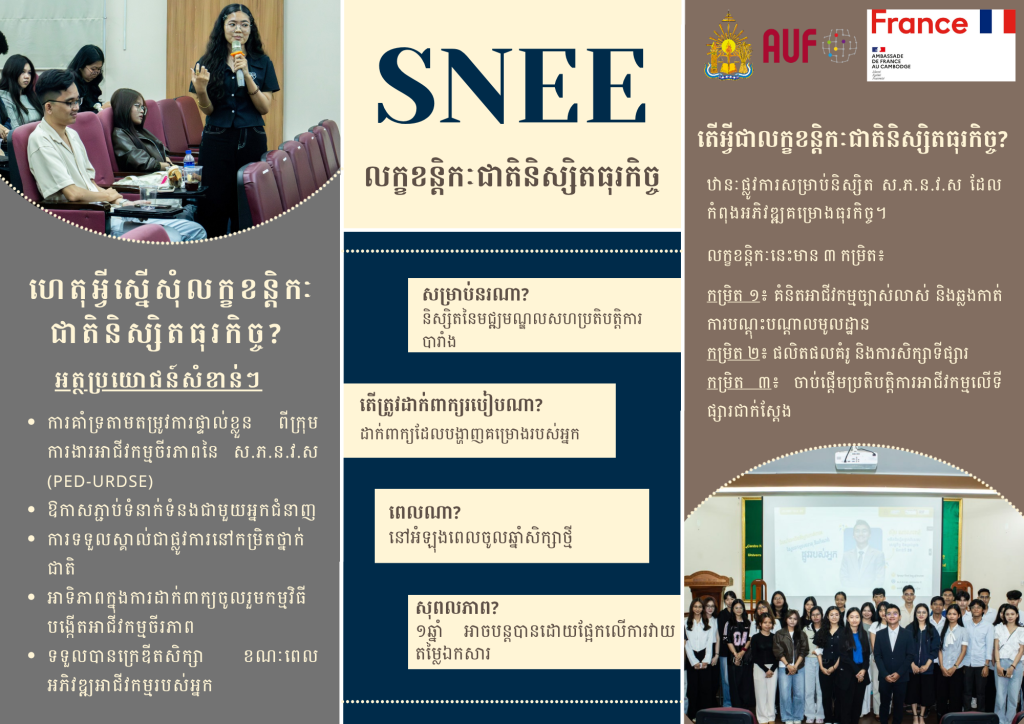
Statut National Étudiant-Entrepreneur (SNEE)
Transformez votre idée en projet d’avenir
Le Statut National Étudiant-Entrepreneur (SNEE) est un dispositif officiel porté par l’Université Royale de Droit et des Sciences Économiques (URDSE), en partenariat avec le Ministère de l’Éducation, de la Jeunesse et du Sport du Royaume du Cambodge et avec le soutien de l’Agence Universitaire de la Francophonie (AUF).
Mis en œuvre par le Pôle Entrepreneuriat Durable (PED-URDSE), également appelé Sustainable Entrepreneurship Lab (SEL-RULE), intégré au Département d’Économie de l’URDSE, le SNEE permet aux étudiants de développer un projet entrepreneurial tout en poursuivant leurs études supérieures.
Que votre projet soit économique, social, culturel, environnemental ou technologique, le SNEE vous offre un cadre reconnu pour concrétiser vos ambitions et intégrer l’entrepreneuriat à votre parcours académique.
Référente SNEE
Luna Aubrée
Référente SNEE – Pôle Entrepreneuriat Durable (PED-URDSE / SEL-RULE)
Responsable des programmes, Département de la coopération française en économie et gestion
Adresse e-mail: dir.eco.rule@gmail.com | Téléphone: +855 86 674 353
Le Pôle Entrepreneuriat Durable (PED)
Le SNEE est administré par le Pôle Entrepreneuriat Durable (PED) – Sustainable Entrepreneurship Lab (SEL-RULE), une unité d’accompagnement à l’entrepreneuriat intégrée au Pôle de Coopération Française de l’URDSE.
Le PED a pour mission de :
- Encourager l’esprit entrepreneurial chez les étudiants ;
- Reconnaître la valeur des projets entrepreneuriaux dans le parcours universitaire ;
- Garantir un accompagnement transparent, homogène et durable ;
- Favoriser l’émergence d’initiatives à impact économique, social et environnemental.
À travers cette initiative nationale, l’URDSE, le Ministère de l’Éducation, de la Jeunesse et du Sport, l’AUF et les universités partenaires contribuent à l’émergence d’une nouvelle génération d’entrepreneurs cambodgiens capables d’innover, de créer des emplois et de participer activement au développement durable du Royaume du Cambodge.
Qu’est-ce que le SNEE ?
Le Statut National Étudiant-Entrepreneur est un statut officiel attribué aux étudiants de l’enseignement supérieur engagés dans une démarche entrepreneuriale.
Le SNEE accompagne toutes les formes d’initiatives entrepreneuriales :
- Création d’entreprise ;
- Développement d’un produit ou service innovant ;
- Projet associatif à fort impact ;
- Organisation d’événements d’envergure ;
- Intrapreneuriat au sein d’une organisation existante.
Ce dispositif constitue un véritable pont entre les études universitaires et le monde entrepreneurial, en offrant aux étudiants les ressources, la reconnaissance et l’accompagnement nécessaires pour transformer leurs idées en projets viables.
Les avantages du SNEE
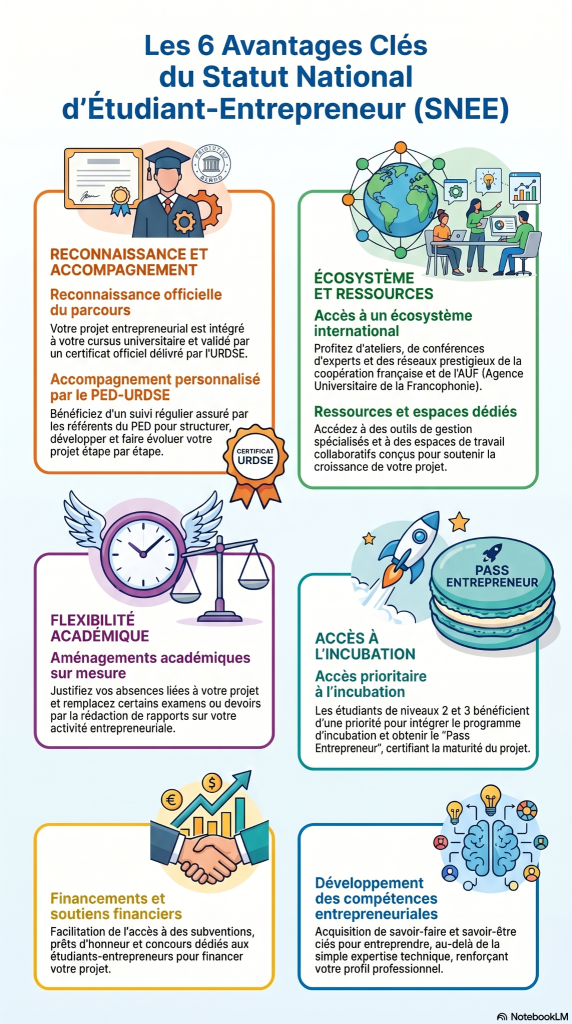
Le Programme d’Incubation d’Entrepreneuriat Durable
Le Programme d’Incubation d’Entrepreneuriat Durable accompagne les étudiants et jeunes diplômés porteurs de projets à fort potentiel économique, social ou environnemental. Piloté par le Pôle Entrepreneuriat Durable (PED), il a pour vocation de transformer des idées prometteuses en initiatives viables, responsables et prêtes à être déployées sur le marché.
L’incubateur est exclusivement ouvert aux étudiants et alumni du Département de Coopération Française. L’obtention du Statut National Étudiant-Entrepreneur (SNEE) constitue un atout majeur pour intégrer le programme, mais l’admission reste soumise à une procédure de candidature et à une sélection par un comité d’experts.
Durant la phase pilote, les projets sélectionnés bénéficient d’un accompagnement intensif combinant ateliers thématiques, séances de coaching individuel et accès à un réseau d’experts et de partenaires. Cet accompagnement vise à renforcer la solidité du modèle économique, la stratégie de développement et l’impact durable des projets.
Le programme s’articule autour de trois axes d’expertise :
- Bancabilité : structuration financière et préparation à la recherche de financements ;
- Croissance : développement commercial, accès au marché et acquisition de clients ;
- Responsabilité : intégration des principes de développement durable, mesure de l’impact et prise en compte des enjeux de genre, de diversité et d’inclusion (GEDSI).
À l’issue du parcours, les entrepreneurs peuvent prétendre à l’obtention du Pass Entrepreneur, une certification délivrée par le comité d’experts attestant de la maturité technique, financière et durable du projet et de sa capacité à mobiliser des partenaires et investisseurs.
Les trois niveaux du SNEE
Le Statut National de l’Étudiant Entrepreneur (SNEE) est attribué en fonction du niveau de maturité du projet entrepreneurial porté par l’étudiant. Trois niveaux sont définis afin de prendre en compte l’évolution du parcours entrepreneurial.
| Niveau | Profil de l’étudiant | Critères | Pièces justificatives requises |
| Niveau 1 | Étudiant en début de parcours entrepreneurial | L’étudiant dispose d’une idée de projet clairement définie et a entamé ou suivi une initiation à l’entrepreneuriat. | • Description écrite du projet (concept, problématique adressée, public cible) ;• Lettre de motivation présentant la démarche entrepreneuriale et les objectifs poursuivis ;• Attestation ou preuve de participation à une formation en entrepreneuriat. |
| Niveau 2 | Étudiant porteur d’un projet innovant | L’étudiant a développé un prototype fonctionnel ou un service intégrant une dimension innovante, technologique ou numérique, et a réalisé une étude de marché. | • Prototype, démonstration fonctionnelle ou présentation du produit/service ;• Étude ou analyse de marché ;• Attestation de formation en entrepreneuriat ;• Lettre de motivation décrivant le caractère innovant du projet ainsi que la feuille de route de son développement. |
| Niveau 3 | Étudiant entrepreneur avec activité établie | L’étudiant exerce déjà une activité économique effective et dispose d’une présence avérée sur le marché. | • Preuve d’enregistrement de l’entreprise (licence, enregistrement officiel, brevet ou document équivalent) ;• Justificatifs d’activité commerciale (factures, contrats, références clients, chiffre d’affaires ou documents équivalents) ;• Présentation synthétique des activités actuelles et des perspectives de développement ;• Lettre de motivation expliquant l’apport du SNEE dans la prochaine phase de croissance de l’entreprise. |
Évaluation des candidatures
Les dossiers sont examinés en fonction du niveau de maturité du projet entrepreneurial et de la cohérence entre les objectifs du candidat, les réalisations présentées et les perspectives de développement envisagées. Le niveau peut être réévalué par le comité lors de la sélection des dossiers.
Conditions de candidature
Les candidatures au SNEE sont ouvertes une fois par an, lors de la rentrée académique.
L’évaluation des dossiers repose notamment sur :
- La motivation du candidat ;
- La clarté et la cohérence du projet présenté ;
- Les démarches déjà engagées ;
- La compréhension des engagements liés au statut ;
- Le potentiel de développement du projet.
L’attribution du SNEE est annuelle et renouvelable. Le renouvellement est conditionné à l’évolution du projet et au développement du produit.
Rejoignez la communauté des étudiants-entrepreneurs !
Vous avez une idée, un projet innovant ou une entreprise en développement ?
Le SNEE vous offre le cadre, l’accompagnement et les opportunités nécessaires pour transformer votre ambition en réussite entrepreneuriale.
Déposez votre candidature et donnez une nouvelle dimension à votre parcours universitaire.
https://forms.gle/xjXMhCPuF69FD75A9

National Status Student Entrepreneur (SNEE)
Turn your idea into a project for the future
The National Status Student-Entrepreneur (SNEE) is an official program led by the Royal University of Law and Economics (RULE), in partnership with the Ministry of Education, Youth, and Sports of the Kingdom of Cambodia and with the support of the Agence Universitaire de la Francophonie (AUF).
Implemented by the Pôle Entrepreneuriat Durable (PED-URDSE), also known as the Sustainable Entrepreneurship Lab (SEL-RULE), which is part of RULE’s Department of Economics, the SNEE enables students to develop an entrepreneurial project while pursuing their higher education.
Whether your project is economic, social, cultural, environmental, or technological, the SNEE offers you a recognized framework to bring your ambitions to life and integrate entrepreneurship into your academic journey.
SNEE Coordinator
Luna Aubrée
SNEE Coordinator – Sustainable Entrepreneurship Lab (PED-URDSE / SEL-RULE)
Head of Programs, French Cooperation Department in Economics and Management
Email Address: dir.eco.rule@gmail.com | Phone: + 855 86 674 353
The Sustainable Entrepreneurship Lab (SEL)
The SNEE is administered by the Sustainable Entrepreneurship Lab (SEL-RULE), an entrepreneurship support unit integrated into the RULE’s French Cooperation Hub.
The SEL’s mission is to:
- Encourage an entrepreneurial spirit among students;
- Recognize the value of entrepreneurial projects within the academic curriculum;
- Ensure transparent, consistent, and sustainable support;
- Foster the emergence of initiatives with economic, social, and environmental impact.
Through this national initiative, RULE, the Ministry of Education, Youth, and Sports, the AUF, and partner universities are helping to foster a new generation of Cambodian entrepreneurs capable of innovating, creating jobs, and actively contributing to the sustainable development of the Kingdom of Cambodia.
What is the SNEE?
The National Status Student-Entrepreneur (SNEE) is an official status granted to higher education students engaged in an entrepreneurial endeavor.
The SNEE supports all forms of entrepreneurial initiatives:
- Starting a business;
- Developing an innovative product or service;
- High-impact nonprofit projects;
- Organization of large-scale events;
- Intrapreneurship within an existing organization.
This program serves as a bridge between university studies and the entrepreneurial world, offering students the resources, recognition, and support they need to turn their ideas into viable projects.
The Benefits of the SNEE
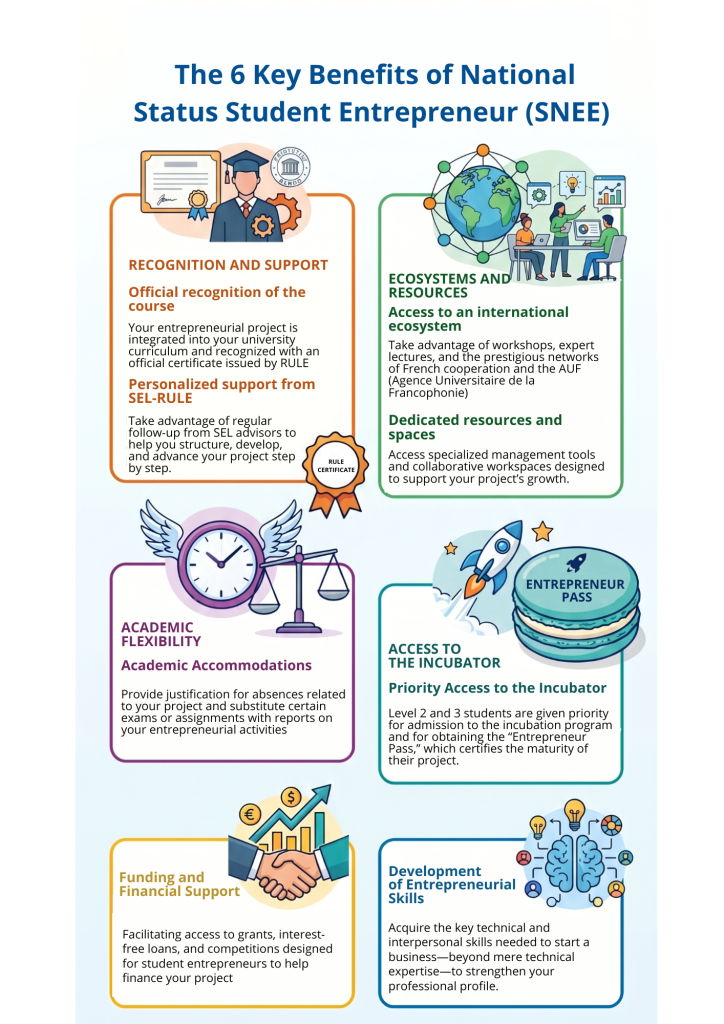
The Sustainable Entrepreneurship Incubation Program
The Sustainable Entrepreneurship Incubation Program supports students and recent graduates with projects that have strong economic, social, or environmental potential. Led by the Sustainable Entrepreneurship Lab (SEL), the program aims to transform promising ideas into viable, responsible initiatives that are ready for market deployment.
The incubator is open exclusively to students and alumni of the Department of French Cooperation. Obtaining National Status Student-Entrepreneur (SNEE) is a major advantage for admission to the program, but acceptance is subject to an application process and selection by a committee of experts.
During the pilot phase, selected projects receive intensive support combining thematic workshops, individual coaching sessions, and access to a network of experts and partners. This support aims to strengthen the projects’ business models, development strategies, and sustainable impact.
The program is structured around three areas of expertise:
- Bankability: financial structuring and preparation for fundraising;
- Growth: business development, market access, and customer acquisition;
- Responsibility: integration of sustainable development principles, impact measurement, and consideration of gender, diversity, and inclusion (GEDSI) issues.
Upon completion of the program, entrepreneurs are eligible to receive the Entrepreneur Pass, a certification issued by the expert committee attesting to the project’s technical, financial, and sustainable maturity, as well as its ability to attract partners and investors.
The Three Levels of the SNEE
The National Status Student Entrepreneur (SNEE) is awarded based on the level of maturity of the student’s entrepreneurial project. Three levels have been defined to reflect the progression of the entrepreneurial journey.
| Level | Student Profile | Criteria | Required Supporting Documents |
| Level 1 | A student just starting out on their entrepreneurial journey | The student has a clearly defined project idea and has either started or completed an introductory course in entrepreneurship. | • Written description of the project (concept, problem addressed, target audience);• Cover letter outlining the entrepreneurial approach and objectives;• Certificate or proof of participation in an entrepreneurship training program. |
| Level 2 | Student with an innovative project | The student has developed a working prototype or a service that incorporates an innovative, technological, or digital element, and has conducted market research. | • Prototype, working demonstration, or presentation of the product or service;• Market research or analysis;• Certificate of completion of an entrepreneurship training program;• Cover letter describing the innovative nature of the project and its development roadmap. |
| Level 3 | Student entrepreneur with an established business | The student is already engaged in actual economic activity and has a proven presence in the market. | • Proof of business registration (license, official registration, business permit, or equivalent document);• Evidence of business activity (invoices, contracts, client references, revenue, or equivalent documents);• A brief overview of current activities and growth prospects;• A cover letter explaining how the SNEE will contribute to the company’s next phase of growth. |
Evaluation of Applications
Applications are reviewed based on the level of maturity of the entrepreneurial project and the consistency between the applicant’s objectives, the achievements presented, and the envisaged development prospects. The committee may reassess the project’s maturity level during the selection process.
Application Requirements
Applications for the SNEE are accepted once a year, at the start of the academic year.
The evaluation of applications is based in particular on:
- The applicant’s motivation;
- The clarity and coherence of the proposed project;
- Steps already taken;
- Understanding of the commitments associated with the status;
- The project’s potential for growth.
The SNEE is awarded annually and is renewable. Renewal is contingent upon the project’s progress and the product’s development.
Join the community of student entrepreneurs!
Do you have an idea, an innovative project, or a startup in the works?
The SNEE offers you the framework, support, and opportunities you need to turn your ambition into entrepreneurial success.
Submit your application and take your academic journey to the next level.
https://forms.gle/xjXMhCPuF69FD75A9