Hello!
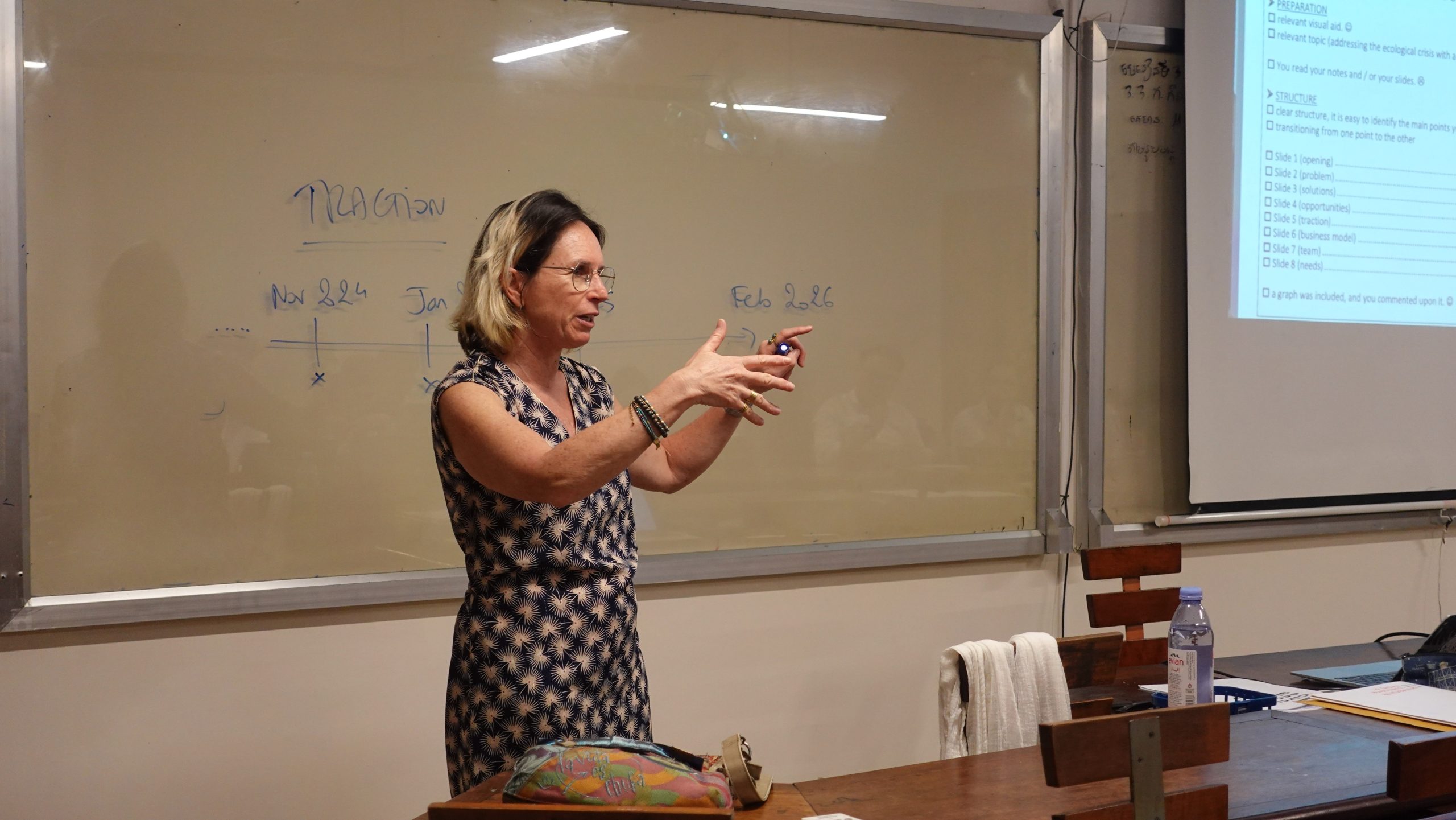
I am a full professor at Université Lumière Lyon 2 (France) and am excited to be one of your lecturers this year. In the second year of the master’s program, I will be guiding you through the “Economics of sustainable development” course. Together, we will explore some of the key challenges of our time: how societies can grow and develop while protecting the planet and its inhabitants, and how we can respond to the climate crisis. Throughout the course, which will be held online and in site in Phnom Penh, you will have to work on a project connected to one of these key issues and have the chance to pitch it like professionals do.
My primary research interests, carried out within the CeRLA Research Group at Université Lumière Lyon 2, lie in the areas of applied linguistics and include discourse analysis, Languages for Specific Purposes (LSP), ethnographic research methods in a specialized context and the description of specialized varieties of English. Another area of interest focuses on language policy, language teaching to students of other disciplines than modern languages and literature, and on the place and role of LSP in European university programs.
More info about my research: https://swozniaksite.wordpress.com/
- What has been your journey leading you to RULE?
I have been teaching undergraduate and graduate students in economics and management since 1998, covering a variety of fields: ecological economics, international economics, social and solidarity economy, sports and tourism economics, human resources and organizational change management, innovation and intellectual property management, management of international SMEs, and more. I teach a course in the “Management of organizations in the social and solidarity-based economy” master’s program at Université Lumière Lyon 2, and so was asked to also teach a hybrid course as part of the dual “Entrepreneurship and Project Management Towards Sustainability” program, co-accredited by Université Lumière Lyon 2 and RULE.
- Can you describe how the course(s) you teach are relevant in the current context?
In a world where environmental challenges are becoming increasingly urgent, integrating meaningful climate education into curricula is no longer optional —it is essential. This course is designed to give master’s students a clear, multidisciplinary understanding of the climate crisis and its far‑reaching impacts. Through scientific, social, economic, and professional perspectives, students will explore the realities of the ecological transition and what it implies for their future careers. The goal is to equip tomorrow’s professionals with the knowledge and skills needed to integrate sustainability into their daily decisions and practices, no matter their fields.
- Can you tell us about your experience as a teacher for an international program in Cambodia?
Getting involved in this international program has been an incredibly enriching experience for me. Working within a multilingual and multicultural environment benefits not only French and Khmer students, but also the entire teaching team. The diversity of perspectives, backgrounds, and academic habits creates a truly dynamic learning atmosphere. Moreover, sustainability issues — and sustainability studies more broadly — are approached very differently in European and Southeast Asian contexts. This contrast makes the course even more relevant, stimulating, and intellectually challenging for everyone involved.
- Do you have any recommendations for future students and graduates?
To prepare for the course, you can start by learning more about its content by visiting the page dedicated to it on my teaching blog (https://swozniak.edublogs.org/6-m2-classes-english-for/epm/). Looking forward to teaching you!

 ភាសាខ្មែរ
 Exchange Programs and Partner Institutions
 Nomination Procedure and Curricula for Exchange Students
 Marking and Grade Equivalence
 Application form for Exchange at RULE