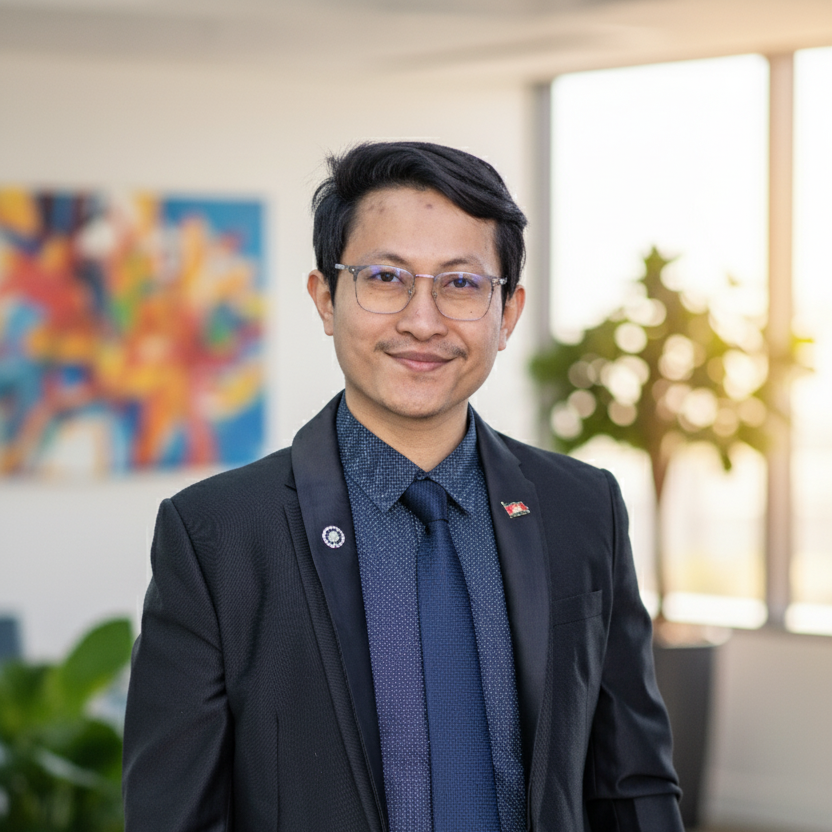
Pisethneat Pich, known as Nick, is an experienced sustainability and leadership professional currently serving as a Sustainability Consultant for major Cambodia exporters. He holds a Master of Commerce in Global Sustainability, Strategy, and Innovation from the University of New South Wales (UNSW) Sydney, Australia.
With years of experience in talent development, organisational restructuring, ethical leadership, and sustainability, Nick has supported over 15 corporates, 20 SMEs, and 20 prototype teams in the technology and agriculture sectors. His keen interest in youth career development has also supported over 800 Cambodian tech talents to reimagine purpose-driven, ethical, and sustainable career pathways in Cambodia.
As a Lecturer of Business Ethics in the Faculty of Economics and Management, Nick brings a practical and human-centred approach to teaching, bridging global ethical theories with real-world sustainability and leadership practices.
What have been your journey leading you to RULE?
My journey to RULE feels like coming full circle. I began my academic path here as a law student at the RULE, completing my degree in 2014 and graduating in 2016. Returning now as a lecturer is both nostalgic and meaningful. It’s a chance to give back to the very institution that shaped my foundation of understanding the differences between the law and ethics.
Since leaving RULE, I’ve spent years working across organisational development, sustainability, and ethical leadership, from mentoring early-stage entrepreneurs and supporting corporates on management practices to leading sustainability transition for responsible business practices.
Teaching at RULE allows me to bring those real-world lessons back into the classroom and help the next generation of professionals see how ethics is not just theoretical, but deeply practical and transformative in business today.
Can you describe how the course(s) you teach are relevant in the current context?
The Business Ethics course is incredibly relevant today, especially in a world facing rapid technological change, sustainability challenges, and evolving corporate responsibilities. Ethical decision-making has become central to how organisations maintain trust, attract investment, and deliver long-term value.
From AI and ethics to sustainability and stakeholder governance, to ethical leadership in complex systems, this course helps students understand how to navigate moral dilemmas and make responsible decisions in their future careers. My goal is to help students move beyond compliance and think about ethics as a foundation for innovation, purpose, and leadership in the 21st century.
Do you have any recommendations for future students and graduates?
Be curious and reflective. Don’t just focus on grades or technical skills; build your ethical compass, your ability to think critically, and your empathy for others. The future of work requires not only intelligence but also integrity and adaptability.
Take every opportunity to learn from real-world experiences, connect with diverse people, and ask tough questions about what’s right, not just what’s profitable. And most importantly, stay true to your values and develop strong self-efficacy; they will guide you when the path ahead seems uncertain.

 ភាសាខ្មែរ
 Exchange Programs and Partner Institutions
 Nomination Procedure and Curricula for Exchange Students
 Marking and Grade Equivalence
 Application form for Exchange at RULE